The problem with conventional thermostats: on or off
A conventional thermostat — including most "smart" thermostats like Heatmiser NeoStat, Nest, or Honeywell — works on a very simple principle. It has a target temperature. When the room falls below that temperature, it switches the heating on. When the room reaches the target, it switches the heating off. Then the room cools again, and the cycle repeats.
This is called bang-bang control, and it means your heating is always running at full power or not at all. The room temperature oscillates — it's never quite stable, always cycling past and below the target. For radiator systems this is often barely noticeable. But for underfloor heating (UFH), which is now standard in most quality new builds and renovations, it's a problem.
Underfloor heating is a slow, thermal-mass system. It takes time to warm up and time to cool down — in a typical screed floor, that lag can be an hour or more. If you're switching it fully on and then fully off based on a room thermostat, you're constantly chasing a target you can never quite hit. The floor overheats past the target, the thermostat cuts power, the floor slowly cools, the thermostat switches power back on, and round it goes. The result is a floor that's either slightly too warm or slightly too cool, and a system that's running less efficiently than it should.
How KNX does it differently
KNX heating control uses a different approach — one that's been standard in commercial building management systems for decades but has become accessible for residential use through KNX. Rather than switching on and off, it varies how much time the heating is on within each cycle.
Here's the plain-English version: imagine the heating is working in ten-minute windows. If the room is significantly below target, the heating runs for nine of those ten minutes. As the room gets closer to target, it runs for seven minutes, then five, then two. When the room is right on target, it might run for just thirty seconds every ten minutes — enough to compensate for the small amount of heat the room naturally loses.
The result is that the floor temperature is maintained continuously and accurately rather than cycling. The room reaches the target temperature and stays there. The heating runs for less total time because it's never wildly overcompensating. And the system responds proportionally to how much heat is actually needed, rather than just switching on and giving everything it has.
Why this matters for underfloor heating specifically: UFH is ideal for this type of control because the floor itself acts as a thermal buffer — it stores heat and releases it steadily. Combined with KNX's precise modulation, a well-designed UFH system maintains a remarkably stable and comfortable floor temperature throughout the day, with very little energy waste.
The comfort difference you'll actually notice
The comfort difference between bang-bang and modulated control is real, but it's the kind of thing you tend to notice in retrospect rather than immediately. Clients who have moved from a Heatmiser system to KNX control on the same underfloor heating often describe the new result as "the house just feels right" without initially being able to articulate exactly why. The floor is consistently warm rather than cycling, the room temperature doesn't drift, and there are none of the moments where you realise you're too warm because the heating caught up all at once.
For clients with young children or elderly family members — where consistent temperature matters more — this is a meaningful quality-of-life improvement rather than a minor technical nicety.
What else KNX gives you that a thermostat can't
Better control of the heating itself is only part of the picture. Because KNX is a whole-home automation bus — every device speaks the same language — the heating integrates properly with everything else.
- Presence-based control. When the last person leaves the house, the heating can automatically drop to a setback temperature. When the first person arrives home (detected via the gate intercom, a key fob, or geofencing from a phone), the heating can return to comfort temperature before they're in the door.
- Weather compensation. KNX systems can read an outdoor weather station and anticipate how much heat the house needs based on external conditions — ramping up on cold days and reducing on mild ones without waiting for the room to cool down first.
- Window contact integration. If a window is opened in a room, the thermostat for that room automatically drops its setpoint — so the heating isn't running to warm a room you're ventilating. When the window closes, it returns to normal.
- Scene integration. A "morning" scene can bring the bedroom to a warmer temperature before your alarm goes off. A "cinema" scene can slightly reduce the temperature in the sitting room, since a room full of people generates its own heat.
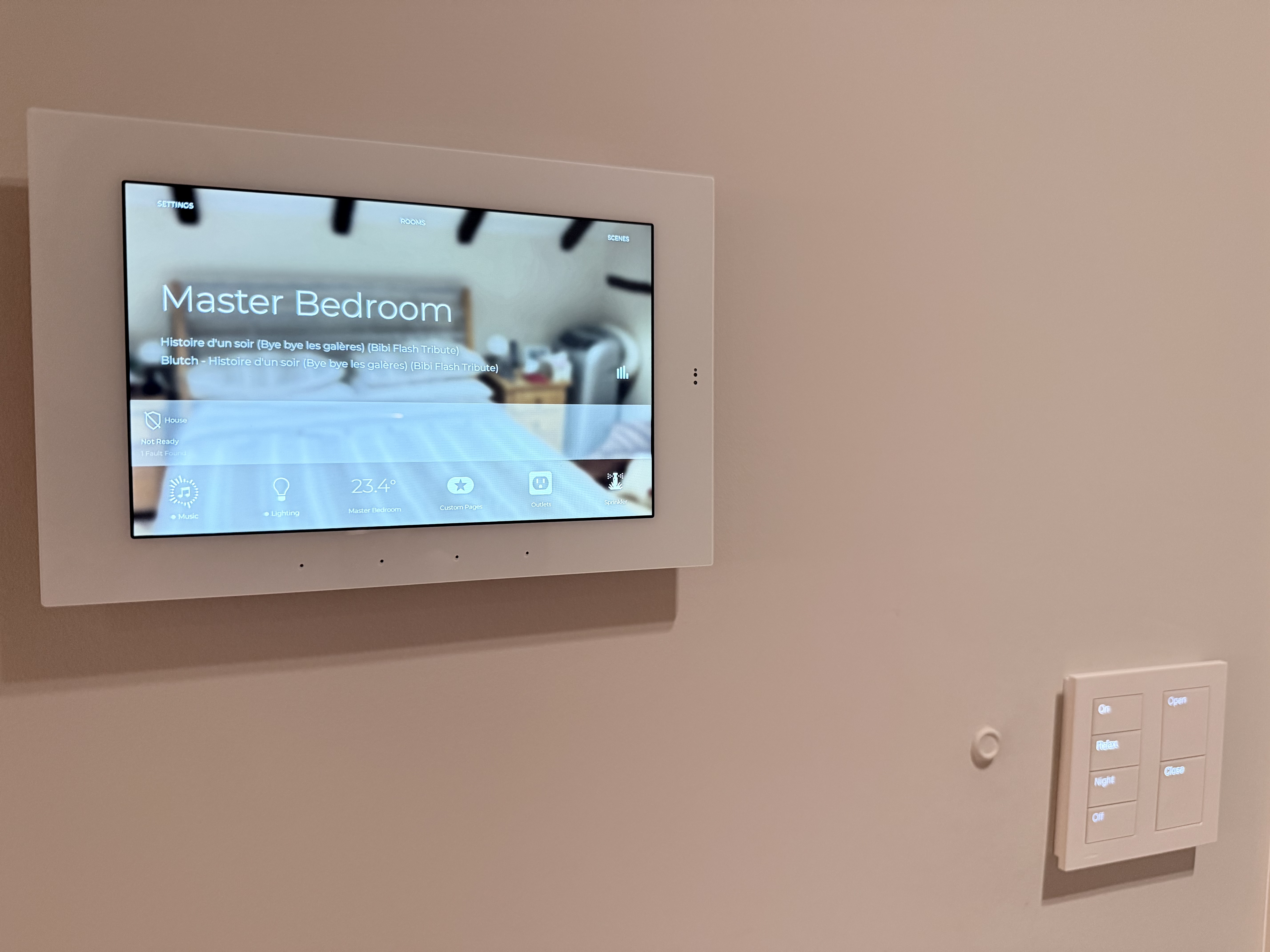
- Single interface. All of this is visible and controllable from the same touchscreen, keypad, or phone app you use for lights, blinds, and AV. Not five separate apps.
Conventional smart thermostat
- On/off control only
- Room temperature cycles above and below target
- Separate app from everything else
- Limited integration with rest of house
- Works well for radiators
- Struggles with underfloor heating
KNX heating control
- Modulated control — varies heating continuously
- Stable, accurate room temperature
- Integrated with lights, blinds, AV, access
- Presence, weather and window awareness
- Works well for radiators and UFH
- Particularly strong on underfloor heating
Is KNX right for every project?
KNX is a wired system — devices communicate over a dedicated bus cable, separate from the power wiring. This means it's most cost-effective when specified during a new build or major renovation, when the building is open and cable can be run economically. Retrofitting KNX into a finished home is possible but involves more disruption and cost.
For finished properties where running new wiring isn't practical, there are wireless alternatives that offer better heating control than a conventional thermostat without a full rewire — and we'll always tell you what's appropriate for your situation rather than pointing you toward the most complex (or most profitable) solution.
For new builds, extensions, and serious renovations, KNX is worth specifying from the outset. The additional installation cost over a conventional system is recovered in energy savings and comfort over time — and the integration capability means the investment delivers value beyond heating alone.
Planning a Build or Renovation?
Talk to us about smart heating control from the start. Getting the specification right at first fix is significantly more cost-effective than retrofitting later — and the result is meaningfully better.