Generation 1: the perimeter wire era
The first generation of robotic mowers — dominated by Husqvarna Automower for much of the last two decades — relied on a perimeter wire buried just below the surface around the boundary of the lawn. The mower would navigate randomly within that boundary, bouncing off an invisible electric fence whenever it reached the edge.
The concept worked, and still does for straightforward rectangular lawns. But the installation was significant: you needed to bury wire around every island bed, pond, tree, and obstacle in the garden. A complex lawn could require hundreds of metres of wire, and if the wire was ever cut — by a fork, a new planting, or an ambitious dog — the mower stopped working and fault-finding was genuinely tedious.
For many clients with formal gardens or complex landscaping, the wire simply wasn't practical. And for anyone renovating or replanting, the idea of committing a buried cable to a fixed boundary was a deterrent.
Generation 2: RTK GPS
The next leap forward was RTK GPS (Real-Time Kinematic positioning). Instead of a buried wire, the mower uses a base station mounted on the house or garden structure, which communicates with satellites to achieve centimetre-accurate positioning. The mower knows exactly where it is at all times and can follow a mapped boundary stored in its onboard computer.
This was a genuine step forward — no wire, repeatable paths, and the ability to mow in systematic lines rather than random patterns (which produces a much better-looking finish). Several brands launched strong RTK products, and they remain excellent choices for many applications.
The limitation is the base station itself. It needs a clear view of the sky, power, and a fixed mounting point. For some properties — particularly those with significant roof overhang, very dense tree canopy, or where a fixed base station is aesthetically unacceptable — it introduces its own complications.
Generation 3: vision-only navigation
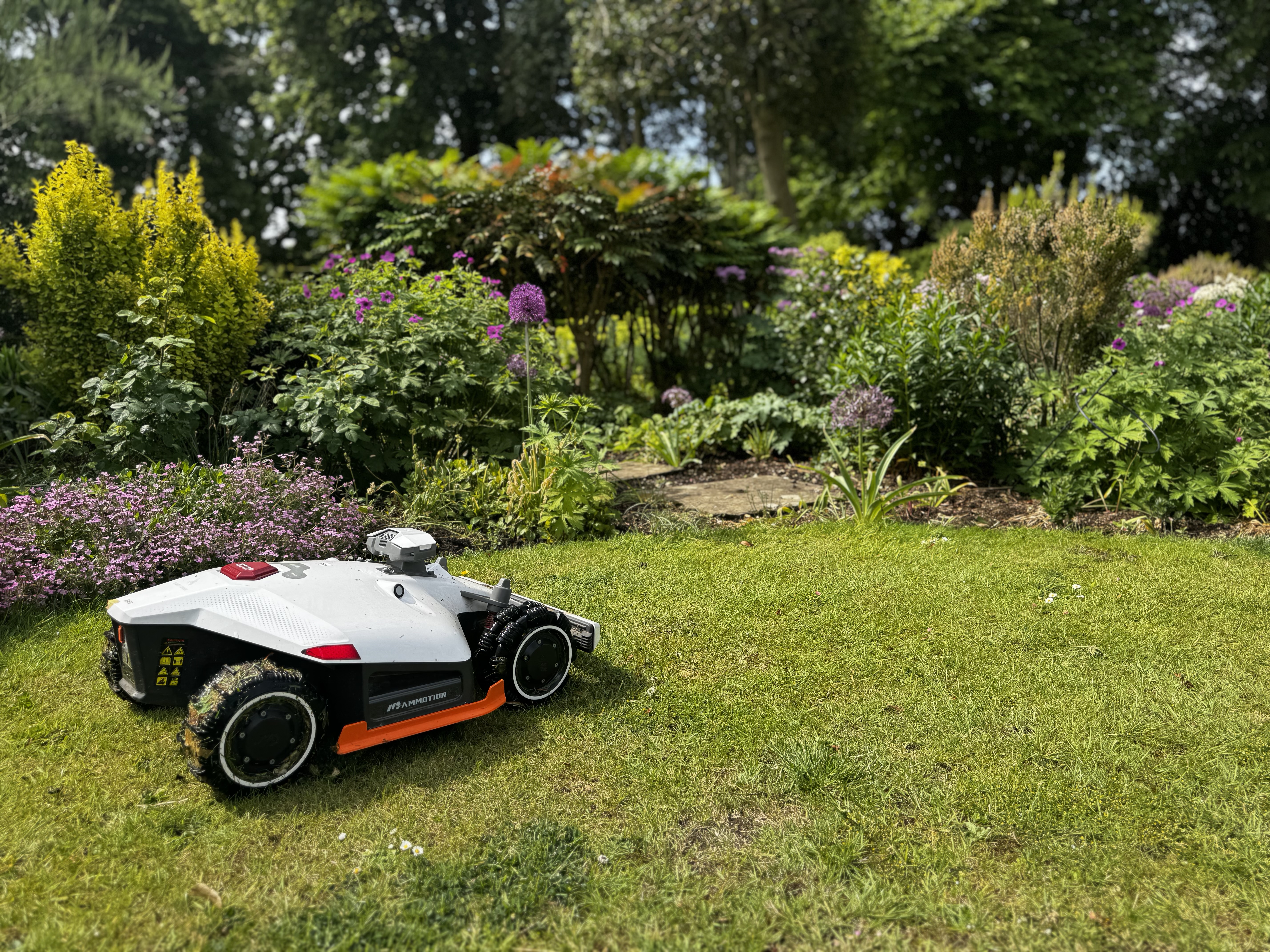
The current generation of Mammotion mowers — the Luba 3 and Luba Mini 2 — takes a different approach entirely. Instead of a buried wire or a GPS base station, they use a combination of cameras, AI object recognition, and standard satellite GPS (without the RTK base station). The mower sees the world, learns the boundaries of the lawn on its initial setup, and navigates accordingly.
The practical implications are significant:
- No wire to install. Setup involves driving the mower around the perimeter of the lawn once during commissioning — that's it. The boundary is stored digitally and can be adjusted at any time via the app.
- No base station. Nothing to mount, power, or maintain. The mower works as a standalone unit.
- Obstacle avoidance. The cameras detect and navigate around objects left in the garden — a child's bike, a garden chair, a pet — without human intervention.
- Multiple zones. The mower can be mapped to cover separate areas of a garden (front and back, for example) without manual intervention between them.
- App control and scheduling. Full remote control, scheduling, and monitoring via the Mammotion app. Integration with smart home platforms is also possible.
We have both the Luba 3 and Luba Mini 2 at our Maidenhead showroom. If you'd like to see them operate in a real garden setting before committing, get in touch and we'll arrange a demonstration.
The benefits that go beyond saving time
Most people focus on the time saving — which is real — but robotic mowers offer lawn health benefits that are less obvious and, arguably, more significant in the long run.
No grass clippings to dispose of. Because a robotic mower cuts little and often (a typical schedule is daily or every other day during the growing season), it only removes a few millimetres of growth at a time. The clippings are tiny — too small to see — and they fall back into the sward, where they decompose and return nitrogen to the soil. This is called mulching, and it's genuinely beneficial for lawn health. A lawn maintained by a robotic mower typically needs less feeding than one cut weekly by a ride-on and collected.
No compaction. Robotic mowers are light — the Luba 3 weighs around 13kg — and the random or systematic paths they follow avoid the repeated tracking lines that heavy mowers create over time. Compaction is one of the main causes of poor drainage and thin turf, so this matters for lawn quality.
No emissions and low noise. Electric motors and lithium batteries mean no petrol, no exhaust, and a noise level that's genuinely unobtrusive — you can carry on a normal conversation standing next to one. For households with young children or for clients who want the garden mowed while they're out, this is a practical advantage.
Consistent cut quality. Because the mower operates on a schedule rather than waiting for the grass to become noticeably long, it maintains an even height throughout the season. The result is a lawn that looks consistently well-kept rather than cycling between overgrown and freshly cut.
Is a robotic mower right for every garden?
Honestly, not quite every garden — but close. Very steep slopes (over about 45%), lawns heavily shaded by dense tree canopy, or gardens with very irregular shapes and narrow corridors can present challenges. We'll always assess your specific garden honestly and tell you if a robotic mower isn't the right fit, rather than push a sale that'll cause frustration.
For the majority of domestic lawns in Berkshire and the Thames Valley — including many that owners assumed were too complex for a robot — the current generation of vision-only mowers handles the job comfortably and impressively.
Interested in a Robotic Mower?
Come and see the Luba 3 and Luba Mini 2 at our Maidenhead showroom — or get in touch to discuss your garden. We'll give you a straight answer about whether it'll work for you.