They're all excellent — the differences are in how they work and who they suit
Savant, KNX and Crestron are all premium, professionally-installed smart home platforms with strong track records and large install bases. Any of them, properly specified and installed, will give you an outstanding result. The differences come down to architecture, flexibility, cost profile, and the kind of project they suit best — not quality.
What follows is a plain-English breakdown of each, and an honest view on where each one fits.
Savant: the most polished day-to-day experience
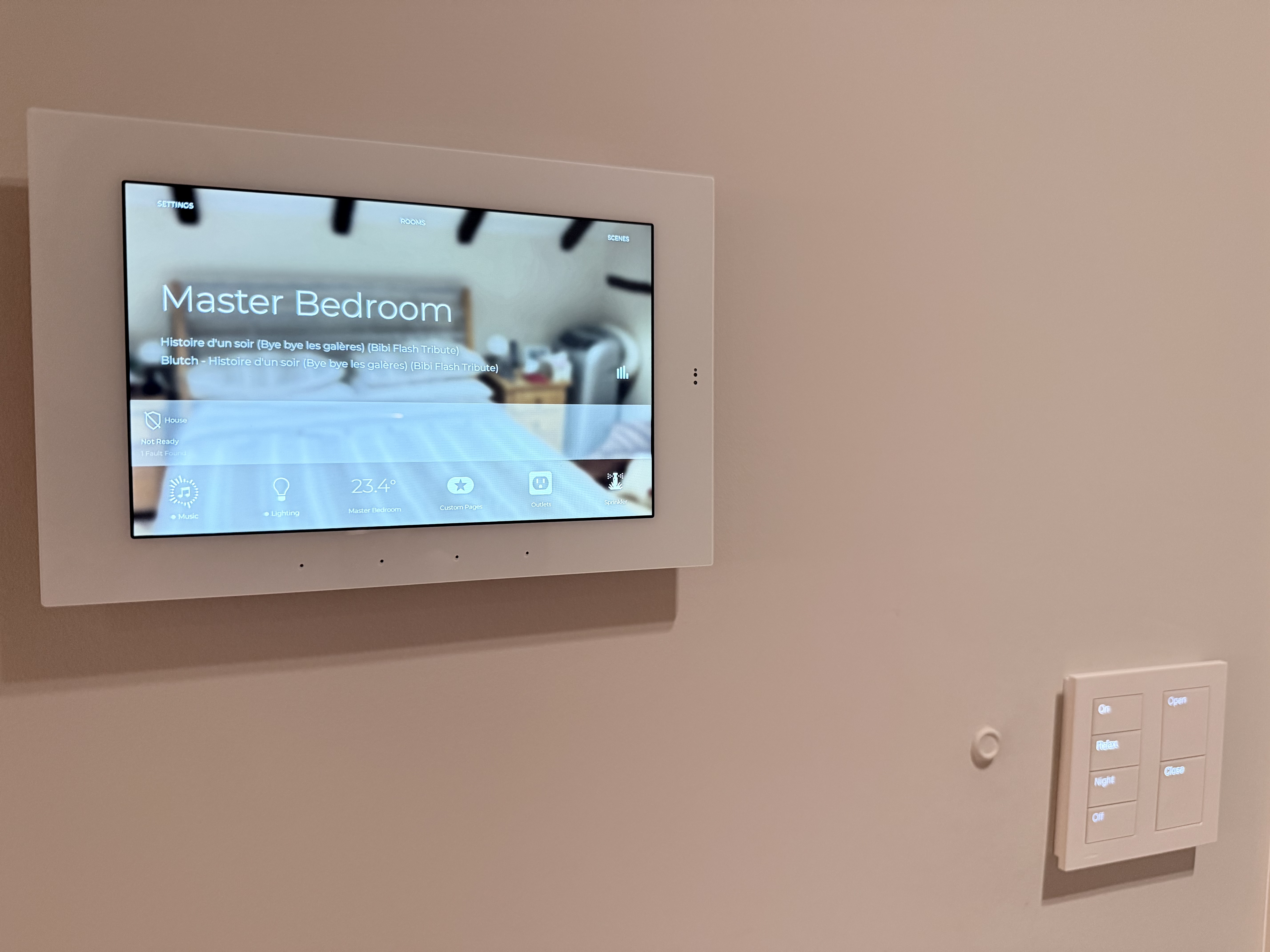
Savant is an American system that has become our most commonly recommended platform for high-end residential projects. Its standout quality is the user interface — the Savant app and touchscreen panels are genuinely beautiful, fast, and intuitive in a way that impresses clients who've lived with other systems. It feels like a premium consumer product rather than a piece of control system software.
Behind the interface, Savant integrates exceptionally well with AV — it grew out of the custom AV world and shows it. Managing multiple zones of audio and video, cinema rooms, multi-display setups, streaming services — Savant handles all of this with less friction than any other platform we use. For a client whose primary drivers are a cinema room, multiroom audio, and smart lighting, Savant is usually our first recommendation.
Savant is a proprietary system installed and programmed by authorised dealers. This means it's professionally supported throughout its life, but changes require an engineer visit or remote access — you can't meaningfully modify the system yourself. For most residential clients this is fine; it's similar to how any premium installed system works.
KNX: the open standard built for the building
KNX is a European open standard — not a product from one company, but a communication protocol supported by over 500 manufacturers. An enormous range of devices carry a KNX logo and can communicate with each other on the same bus: light switches, dimmers, thermostats, blinds controllers, energy meters, weather stations, access control, and much more.
This openness is KNX's biggest strength. Because so many manufacturers make KNX-compatible devices, you can specify exactly the right product for every situation — a Lutron dimmer here, a Gira keypad there, a Siemens HVAC controller for the underfloor heating — and they all speak the same language. There's no dependency on one manufacturer staying in business or continuing to support a particular product line.
KNX is wired at its core — devices communicate over a dedicated two-wire bus that's run during first fix, separate from the power wiring. This makes KNX most cost-effective in new builds and major renovations. It also makes it exceptionally reliable: a wired bus is more stable than any wireless protocol, and KNX installations regularly run for 20+ years without issue.
For clients who care deeply about heating and energy management, building physics, or long-term flexibility, KNX is often the right answer. It's also the platform of choice for very large or complex projects where the breadth of compatible devices matters.
Crestron: the enterprise benchmark
Crestron is the oldest and most established name in control systems, with a heritage in commercial and corporate AV that crosses over into high-end residential. It's the platform most commonly specified by architects and interior designers who have experience with control systems, and it has a strong following in the ultra-high-end residential market.
Crestron's strength is its depth. It can do virtually anything — the programming environment is powerful enough to handle almost any integration requirement, and the hardware range is comprehensive. For very large estates, multi-building projects, or clients with highly specific requirements, Crestron's flexibility is genuinely unmatched.
The trade-off is complexity and cost. Crestron programming is specialist work, and a well-executed Crestron installation at the residential level represents a significant investment. It's the right choice when the project genuinely needs its capability — not for every project.
Savant
- Outstanding user interface
- Excellent AV integration
- Proprietary, dealer-installed
- Best for: AV-led projects, cinema, multiroom audio
KNX
- Open standard, 500+ manufacturers
- Wired, extremely reliable
- Superb heating & energy control
- Best for: new builds, complex projects, long-term flexibility
Crestron
- Maximum programming depth
- Broad hardware range
- Higher cost and complexity
- Best for: large estates, highly specific requirements
Can they work together?
Yes — and many of our larger projects do exactly this. KNX for lighting and heating, Savant as the user-facing control layer and AV backbone, with Crestron managing a specific integration where its depth is needed. The platforms communicate via standardised protocols (IP, RS-232, relay) and a well-designed system uses each where it excels.
This isn't complication for its own sake — it's about specifying the right tool for each job. A KNX heating installation that's controlled through a Savant interface gives you the best of both: precision heating control and a beautiful, intuitive interface your family will actually use.
Our honest position: we lead with Savant for most residential projects because the user experience is exceptional and it handles AV integration better than the alternatives. We specify KNX where heating, energy management, or long-term flexibility is the priority — or where a new build justifies the wired infrastructure. Crestron comes in when the project genuinely needs its depth. We'll tell you which one fits your project, not the one with the best margin.
Not Sure Which Platform You Need?
Tell us about your project and we'll give you a straight recommendation. No sales pressure — just honest advice from installers who work with all three.