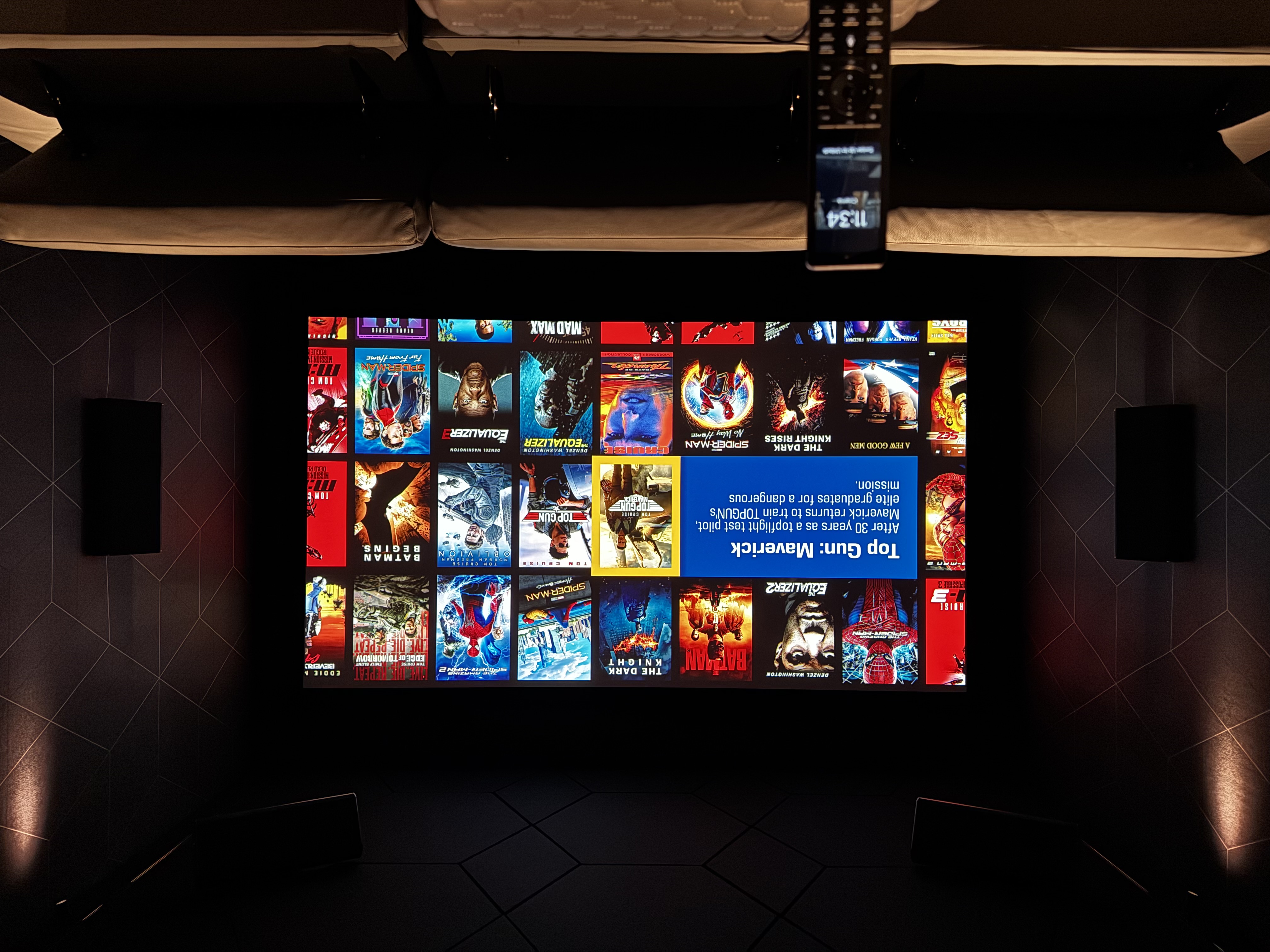
The public cinema's dirty secret: it's designed for throughput, not experience
Your local multiplex is an impressive piece of engineering — but it's optimised to move thousands of people through a building every day, not to give any individual the best possible viewing experience. The seats are arranged so nobody has a completely perfect sightline. The audio is calibrated once and left. The picture brightness is often turned down to extend lamp life between services. And the room itself — shared with strangers, subject to late arrivals, mobile phone glow and the ambient sound of the building — is a compromise from the start.
None of this is a criticism. Public cinemas do an impressive job within significant operational constraints. But when you're designing a dedicated space in a private home with none of those constraints, the outcome can be categorically better.
The picture: 4K laser projection, properly calibrated
Most commercial cinemas still use 2K digital projection — the standard adopted in the early 2000s and still widespread today. High-end venues have moved to 4K laser, which is genuinely excellent, but the majority of mainstream screens haven't.
A well-specified home cinema uses a 4K laser projector calibrated specifically for that room. Calibration involves setting the correct colour temperature, gamma curve, peak brightness and black level for the actual screen, at the actual throw distance, in the actual ambient light conditions. This is done with a colorimeter and specialist software, not guesswork — and it makes an enormous difference to how the image looks compared to a factory-default setup.
The result is a picture that's more accurate, more nuanced in its shadow detail, and more natural in its colour rendering than most of what you'll see in a public venue. On a screen sized appropriately for the room — typically 120" to 150" diagonally in a dedicated home cinema — it's a genuinely cinematic experience.
Lamp vs laser: Traditional projectors use a high-pressure lamp that dims significantly over its 2,000–4,000 hour life. Laser light sources maintain consistent brightness for 20,000+ hours and don't require lamp replacement. For a home cinema used several times a week, this is a meaningful practical difference.
The sound: Dolby Atmos done properly
Dolby Atmos is now a household name — but there's an enormous difference between a soundbar claiming "Atmos-compatible" and a properly implemented object-based surround sound system in an acoustically treated room.
In a dedicated home cinema, we typically run 7.1.4 or 9.1.4 channel layouts: seven surround channels at ear level, four overhead channels in the ceiling, and a subwoofer (sometimes two). The overhead channels are the key — Atmos encodes audio as objects in three-dimensional space, and ceiling-mounted speakers reproduce the vertical dimension in a way that no soundbar or floor-standing speaker can replicate. Rain falling on a rooftop sounds like it's actually above you. A helicopter passes over and you instinctively look up.
The speakers themselves matter enormously. We work with brands including Artcoustic, Krix, and LEON — manufacturers who design speakers specifically for cinema installation, with controlled dispersion patterns and frequency responses engineered for the distances and angles typical in a cinema room. These are very different products from the floorstanding hi-fi speakers most people are familiar with.
Acoustic treatment — panels, bass traps, diffusers — addresses the room itself. Without it, even excellent speakers will produce a muddy, uneven result because the room's reflections interfere with the direct sound. A treated room sounds precise, controlled and immersive. An untreated room — even with the same speakers — sounds like a room.
The experience: everything the multiplex can't offer
Beyond the technical specifications, there are things a home cinema does that a public one simply cannot:
- No adverts, no trailers you didn't choose. Your film starts when you want it to.
- Pause for a drink, a conversation, or a visit to the bathroom without missing anything.
- Your own seating. Properly specified cinema chairs — tiered if the room allows — configured specifically for the room's dimensions and sightlines.
- Complete control over the environment. Temperature, lighting levels (including subtle scene lighting during titles), and start time are all yours to set.
- No other people. No late arrivals, no phone screens, no rustling. Just the film.
- Integration with the rest of the house. A Savant or KNX scene can dim the lights throughout the house, close the blinds, power on the system and have everything ready before you sit down — all from a single button press.
What does a dedicated home cinema actually need?
The room is the most important component. A cinema performs best in a space that can be fully light-controlled (no windows, or very effective blackout), has reasonable dimensions (roughly 5m × 4m minimum for comfortable tiered seating, though smaller rooms can work well), and can be acoustically treated without compromising the architecture.
Basements are popular partly because they often satisfy all three conditions naturally — no windows, solid construction, and a space that was previously underutilised. But dedicated cinema rooms are also installed in converted garages, loft conversions, and purposefully designed media rooms in new builds. The key is designing the room and the system together, rather than retrofitting equipment into an unsuitable space.
From there, the core components are: a 4K laser projector, an acoustically appropriate screen, a Dolby Atmos processor and amplification, carefully positioned speaker array, acoustic treatment, tiered seating, and control integration. We handle all of it — from initial room assessment and design through to final calibration and handover.
New build or renovation? If your project is still at the structural stage, tell us early. Cable routes, conduit, acoustic isolation between floors, and ventilation for equipment all need to be considered before walls are closed. It costs a fraction of what retrospective work costs, and the results are significantly better.
Thinking About a Home Cinema?
Whether you're at the planning stage or just curious about what's possible, we're happy to talk it through. We have a demonstration cinema at our Maidenhead showroom.